Best AI Tools for Product Managers: From Ideation to Launch

Product managers have always lived at the intersection of strategy, data, and execution. The challenge is constant context switching — analyzing feedback, writing PRDs, tracking metrics, running sprints, and aligning teams.
AI tools are quietly transforming that workflow. From user research to roadmap planning and competitor analysis, they’re helping PMs save time and make sharper decisions.
At ATB, we’ve reviewed dozens of AI products designed specifically for PMs. Below is a curated list of the best tools every product manager should explore — grouped by what they actually help you do.
1. Notion AI — Your thinking and writing assistant
Website: notion.so
Notion AI helps PMs write faster, summarize meetings, and organize knowledge in one place. Integrated directly into Notion pages, it’s ideal for drafting specs, summarizing documents, or structuring project notes.
Key strengths:
Auto-summarize meeting notes and user interviews
Turn ideas into structured PRDs
Rewrite or simplify technical content for different audiences
Integrated into your existing Notion workspace
Best for: PMs who want an all-in-one workspace with AI-powered writing and organization.
2. Productboard — AI-driven prioritization and feedback synthesis
Website: productboard.com
Productboard’s AI features analyze user feedback across multiple channels to detect themes, identify feature requests, and help with prioritization.
Key strengths:
Automatically clusters qualitative feedback
Scores opportunities based on user impact
Links customer insights to roadmap items
Provides summarized insight reports
Best for: PMs managing large volumes of customer input or complex multi-product portfolios.
3. Linear Insights — Smarter sprint and issue management
Website: linear.app
Linear has recently added AI features that help summarize issue threads, suggest sprint goals, and auto-generate changelog updates.
Key strengths:
AI summaries for bug reports and discussions
Auto-generated release notes
Fast, keyboard-first UX for power users
Integrations with GitHub, Slack, and Figma
Best for: PMs and engineering leads managing fast product cycles.
4. Dovetail — AI-powered user research analysis
Website: dovetailapp.com
Dovetail uses AI to transcribe interviews, extract insights, and detect recurring themes across user feedback.
Key strengths:
AI tagging and sentiment analysis for research data
Automated highlight reels and summaries
Search across projects and themes
Works seamlessly with Figma and Notion
Best for: Research-driven PMs who need to translate qualitative insights into actionable decisions.
5. ClickUp Brain — AI built into your task management
Website: clickup.com
ClickUp Brain acts as a built-in assistant for project management. It generates meeting summaries, converts chat messages into tasks, and answers questions about project context.
Key strengths:
Auto-creates tasks from chat discussions
Generates stand-up summaries and status reports
Explains complex project updates in plain language
Connects with docs, goals, and dashboards
Best for: PMs leading cross-functional teams who rely on ClickUp for planning.
6. Aha! Ideas — AI for roadmap and idea scoring
Website: aha.io
Aha! has built AI capabilities directly into its idea management and roadmapping platform. It helps you analyze user ideas, generate feature briefs, and simulate roadmap outcomes.
Key strengths:
AI-assisted idea categorization
Auto-drafts feature descriptions and value statements
Predicts potential user impact based on historical data
Best for: Strategic PMs balancing multiple inputs to define high-impact roadmaps.
7. Miro Assist — Accelerated brainstorming and alignment
Website: miro.com
Miro’s AI helps teams brainstorm faster by suggesting clusters, summarizing sticky notes, and transforming messy whiteboards into structured ideas.
Key strengths:
Grouping ideas and summarizing discussions
Auto-generate mind maps and flow diagrams
Suggest next steps after workshops
Great for hybrid or remote workshops
Best for: PMs running strategy sessions or cross-team brainstorming.
8. Athenic AI — Automated analytics and dashboards
Website: athenic.io
Athenic AI connects directly to your data sources and lets PMs ask natural-language questions to analyze metrics without writing SQL.
Key strengths:
Connects to databases, CRMs, and analytics tools
Generates visual charts and summaries instantly
Helps identify anomalies or trends automatically
Best for: PMs who want self-serve analytics without depending on data teams.
9. Userflow — AI onboarding and UX improvement
Website: userflow.com
Userflow now integrates AI-driven onboarding suggestions and copywriting for in-app flows. It identifies drop-off points and recommends improvements.
Key strengths:
AI assistant for onboarding copy and UX flow optimization
Segment-based customization for user journeys
Real-time testing and iteration
Best for: PMs focused on activation, onboarding, and retention.
10. ChatGPT & Custom GPTs — Your personal product co-pilot
Website: chat.openai.com
ChatGPT remains one of the most versatile tools for PMs. With Custom GPTs, you can build your own AI assistant that understands your roadmap, PRDs, and team vocabulary.
Key strengths:
Generate PRDs, user stories, or competitive summaries instantly
Summarize long Slack threads or meeting transcripts
Brainstorm new features, naming ideas, or positioning statements
Build a custom GPT trained on your company docs
Best for: PMs who want a personal, context-aware AI assistant across daily workflows.
How to Build an AI-First Product Management Stack
Modern product management isn’t about using one AI tool — it’s about connecting the right ones. Here’s how top PMs are creating their own AI workflows:
Capture insights: Use Dovetail and Productboard to synthesize feedback.
Plan and prioritize: Rely on Aha! or Linear to define and scope roadmap items.
Design and align: Use Miro or Notion AI for workshops and documentation.
Execute: Track and automate updates in ClickUp or Linear.
Analyze: Use Athenic AI or ChatGPT for metric reviews and post-mortems.
The goal isn’t just automation — it’s amplification. AI gives PMs more time for strategic thinking, better context for decisions, and deeper visibility across the product lifecycle.
Final Thoughts
The role of a product manager has always been about focus and judgment. AI doesn’t replace those skills — it enhances them.
The PMs who win in this new era will be those who learn to integrate AI into their daily rhythm: idea generation, synthesis, prioritization, and storytelling.
These tools won’t just make your workflow faster — they’ll make your insights sharper, your decisions smarter, and your products more user-centered.
To explore more curated AI tools for PMs, visit AI ToolBook — your gateway to discovering the best tools for the next generation of product leaders.
ATB Editorial Team
Engineers, Product Managers, Designers
More From This Author
The good news? Artificial intelligence is leveling the playing field. From ideation and scripting to editing, thumbnails, SEO, and analytics — AI tools are now helping creators do in hours what used to take days.
At ATB, we’ve reviewed hundreds of tools in this space. Below is a curated list of the best AI tools every YouTuber should know , along with their unique strengths and use cases.
1. VidIQ — Smarter SEO and channel optimization Website: vidiq.com
VidIQ remains the gold standard for understanding what drives YouTube visibility. It analyzes keywords, competitor performance, and engagement metrics to help you decide what to post next.
Key strengths:
Real-time keyword and tag recommendations
AI title and description generator
Trend alerts based on audience interests
Channel performance tracking across competitors
Best for: Creators who want data-driven growth and smarter content planning.
2. OpusClip — Turn long videos into viral shorts Website: opus.pro
OpusClip automatically identifies the most engaging moments in a long video and turns them into short, shareable clips optimized for TikTok, Instagram Reels, and YouTube Shorts.
Key strengths:
Auto-captioning and dynamic subtitles
AI highlights detector and scene summarizer
Viral score prediction for each clip
Best for: Podcasters, streamers, and educators who want to repurpose long content quickly.
3. Descript — Edit video by editing text Website: descript.com
Descript reinvented editing by letting you modify videos the same way you edit a document. Delete filler words, fix mistakes, and add new narration with your cloned voice.
Key strengths:
Text-based video editing and overdub voice cloning
Multitrack audio + video editor
Screen recording and collaborative workflows
Best for: Creators who want fast editing without juggling complex timelines.
4. Pictory — Script-to-video automation Website: pictory.ai
Pictory converts written content — blogs, scripts, or notes — into ready-to-publish videos with stock footage, background music, and subtitles.
Key strengths:
AI script analysis and scene breakdown
Automatic captioning and branded templates
Vast stock video and audio library
Best for: YouTubers who post educational or narrated content regularly.
5. ElevenLabs — Realistic voiceovers in minutes Website: elevenlabs.io
If you prefer not to record your own voice every time, ElevenLabs offers highly natural AI voices with multilingual support and emotional range.
Key strengths:
Ultra-realistic voice cloning
Tone and emotion control
Multi-language narration
Best for: Faceless YouTube channels, tutorials, and multilingual creators.
6. Synthesia — Avatar-based video creation Website: synthesia.io
Synthesia enables you to generate professional videos using virtual avatars that lip-sync your script in over 120 languages.
Key strengths:
150+ avatars with full body motion
Instant text-to-video conversion
Custom avatar branding
Best for: Tutorials, explainer videos, or creators scaling multilingual channels.
7. Runway — AI editing and cinematic effects Website: runwayml.com
Runway brings pro-grade AI editing tools like background removal, motion tracking, and text-to-video generation — all inside a browser.
Key strengths:
Magic Eraser for removing objects
Text-to-video generation and scene retouching
Integration with Premiere Pro and Final Cut
Best for: YouTubers who want cinematic quality without studio software.
8. Thumbnail AI — Design thumbnails that convert Website: thumbnail.ai
Thumbnails can make or break a video. Thumbnail AI uses predictive analytics and A/B testing to design thumbnails that get more clicks.
Key strengths:
AI thumbnail grader and CTR prediction
Instant design templates with title overlay suggestions
Color and layout optimization for each niche
Best for: Creators looking to improve CTR and brand consistency.
9. Lumen5 — Turn text and blog posts into video scripts Website: lumen5.com
Lumen5 automatically converts long articles or blog posts into short, visually appealing videos — a great way to repurpose content for YouTube.
Key strengths:
AI storyboarding and scene layout
Brand customization
Large stock footage and soundtrack collection
Best for: Thought leaders and marketers who want to convert ideas into short videos.
10. TubeBuddy — Channel analytics and A/B testing Website: tubebuddy.com
TubeBuddy has long been a favorite among serious YouTubers for optimizing content, testing thumbnails, and managing large video libraries.
Key strengths:
A/B thumbnail and title testing
Tag and SEO suggestions
Bulk updates for playlists and metadata
Best for: Mid-to-large channels looking to optimize performance and save time.
How to Build an AI-First YouTube Workflow AI tools work best when they fit into a repeatable workflow. Here’s a simple structure successful creators use:
Ideate: Use ChatGPT or VidIQ to find topics.
Script: Draft with Notion AI or Pictory.
Record or Generate: Use Synthesia or ElevenLabs for video narration.
Edit: Finalize with Descript or Runway.
Repurpose: Create Shorts with OpusClip or Lumen5.
Optimize: Track analytics with TubeBuddy or VidIQ.
Design: Finalize thumbnails with Thumbnail AI or Canva.
Once you standardize this loop, you can publish faster, maintain quality, and grow consistently — all while reducing workload.
Final Thoughts YouTube success is no longer limited by production resources. What matters now is creativity, consistency, and smart automation.
The right AI stack turns a solo creator into a full-scale production team. Whether you’re editing your first vlog or scaling a monetized channel, these tools will help you focus on what truly matters — ideas, storytelling, and connection.
If you want to explore more AI tools tailored for creators, visit AI ToolBook — your gateway to discovering the smartest tools in the creator economy.
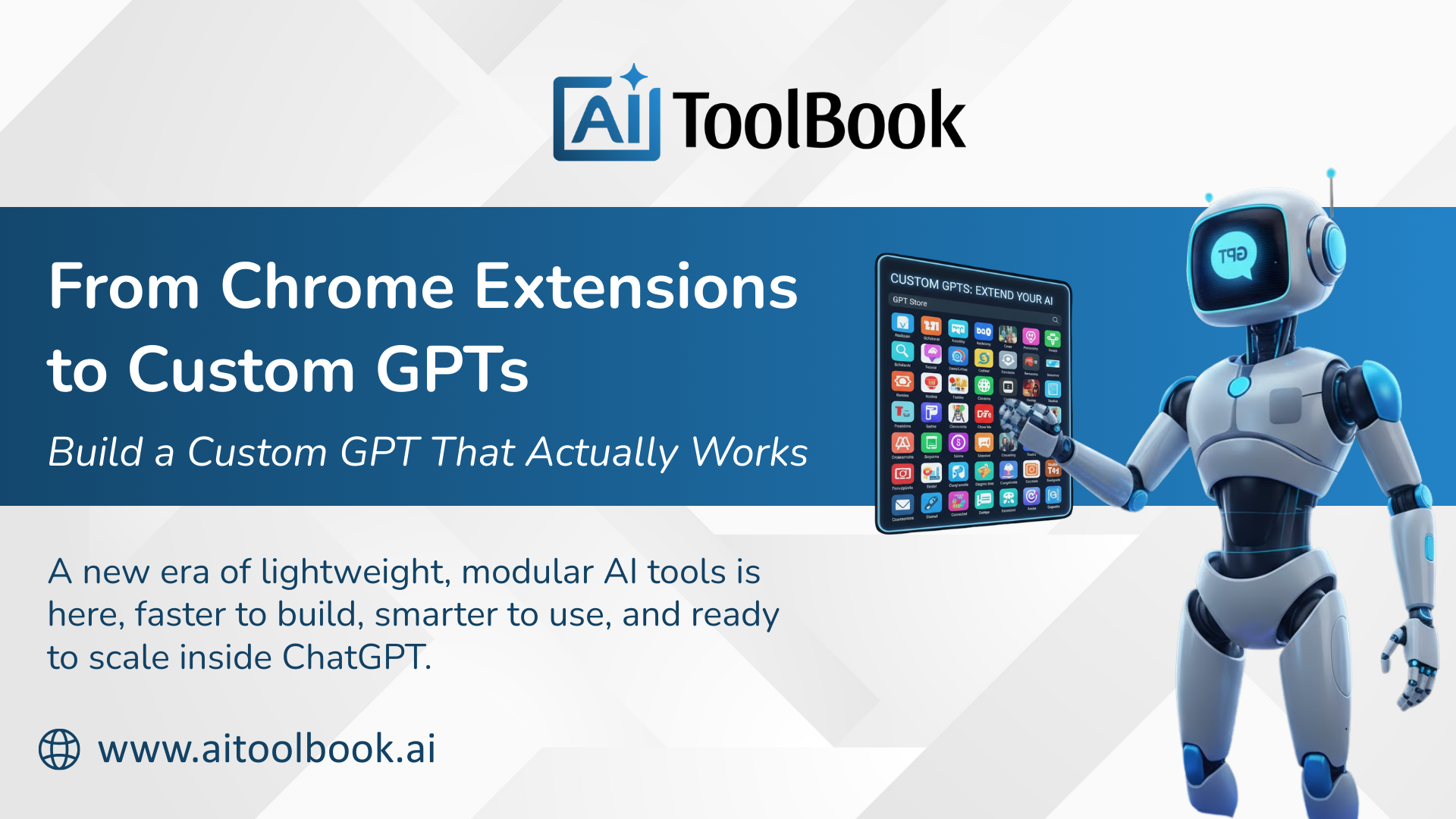
The idea feels familiar: Chrome extensions turned a browser into a platform; Custom GPTs are doing the same for conversational AI. But unlike browser extensions that added UI features, these GPTs extend intelligence — context, data, and task automation — inside a chat interface.
So, what does this new ecosystem look like, and how do you build one that actually works?
The rise of the Custom GPT ecosystem When OpenAI launched the GPT Store, it turned ChatGPT from a single product into an ecosystem. Within months, thousands of Custom GPTs appeared — covering productivity, marketing, coding, design, research, travel, and niche verticals.
You can now find specialized GPTs for nearly every use case:
ScholarAI for academic research and citation-ready answers.
Canva GPT that connects directly to design workflows.
KAYAK and Expedia GPTs for travel planning inside chat.
Diagrams: Show Me for instant visualizations.
AI PDF Reader and AskYourDocs for document analysis.
Consensus GPT for summarizing scientific papers.
The key shift here is accessibility. You don’t need to code an app, build a front-end, or host servers. A well-configured Custom GPT, powered by GPT-4 or GPT-5, can act as a standalone product. That’s why creators and startups are now treating GPTs as their first MVPs — fast to launch, cheap to iterate, and instantly discoverable inside a store with millions of active users.
Why do they mirror Chrome extensions Think about what made Chrome extensions so powerful: small, single-purpose utilities that solved narrow problems. Custom GPTs operate on the same logic.
Each GPT sits on top of ChatGPT’s base model but maintains its own knowledge , instructions , and API actions, making it a personalized expert. Where a Chrome extension added a button to your browser, a Custom GPT adds a new “brain” to your workspace.
As with the Chrome Web Store, discoverability will soon shape success. Expect leaderboards, ratings, reviews, and monetization features. Users will install GPTs for the same reasons they once installed extensions: to automate workflows, save time, or personalize their experience.
What makes a good Custom GPT actually work Most Custom GPTs today fail for the same reason early extensions did: they don’t solve a meaningful problem. A good GPT feels like a specialist , not a demo. The best ones have:
A sharp use case: A focused purpose always beats a broad one. “Create ad copy for SaaS founders” performs better than “Write marketing content.” The clearer the use-case, the more useful the GPT.
Structured knowledge: Uploading PDFs or documents isn’t enough. The best GPTs provide structured context — FAQs, frameworks, terminology, or data schemas — so the model can respond consistently.
Tool integrations: Actions transform a GPT from static to interactive. By connecting APIs (e.g., Google Sheets, Notion, Shopify, or Zapier), your GPT can pull live data, generate output, or trigger workflows.
Clear personality & tone: Instructions define its communication style. Some GPTs sound like consultants, others like teachers or creative partners. Consistent tone creates trust and differentiation.
Strong onboarding: The first interaction should show value in under 60 seconds. Top GPTs include an example prompt, a welcome message, and a quick demo output to orient users.
Tools that simplify building Custom GPTs You don’t need to be an engineer to build one. OpenAI’s GPT Builder handles configuration and testing directly inside ChatGPT. But if you want to go further — connect data, APIs, or automate workflows — these tools can help:
Zapier AI Actions – Connects GPTs to 6,000+ apps, so users can take real actions (send an email, update a spreadsheet, post on Slack).
Bubble or Softr – Wrap your GPT in a simple web front-end if you want a branded experience.
Airtable / Notion Databases – Store structured data or prompts the GPT can query.
AI ToolBook – (yes, our favorite) to discover trending GPTs and analyze positioning before launching your own.
Typedream + GPT API – Build lightweight landing pages that integrate directly with your Custom GPT link.
Use-cases and examples gaining traction Some categories are exploding in the GPT Store:
Marketing & copywriting – GPTs like “AdWizard” and “ContentGen Pro” offer quick, brand-consistent outputs for startups and agencies.
Education – “TutorGPT” and “Math Mentor” are becoming classroom staples.
Real estate, law, and healthcare – GPTs trained on domain-specific materials provide compliant, context-aware responses.
Personal productivity – “Meeting Note Taker,” “Goal Planner,” and “Email Rewriter” simplify repetitive tasks.
Data & research – Tools like “Data Analyst GPT” or “TrendLens” analyze datasets, summarize reports, and visualize insights.
As more users start relying on GPTs for work, expect to see team-level subscriptions, enterprise admin controls, and collaboration features — similar to how Chrome extensions evolved for business users.
Designing for longevity and discoverability Building a GPT that works isn’t the same as building one that lasts. Here’s what separates durable GPTs from disposable ones:
Niche focus : Find a small but high-value audience. “AI Resume Coach” may not go viral, but professionals will use it daily.
Consistent updates : Refresh instructions, examples, and sources monthly.
Analytics mindset : Track user interactions and refine responses based on feedback.
Ethics and reliability : Be transparent about data use and knowledge sources — users trust clarity.
Branding and visibility : Add a distinct name, icon, and tone. In a crowded store, recognizable branding wins.
The next frontier: monetization OpenAI is gradually opening monetization pathways — from featured placements to revenue sharing. Expect GPT builders to earn through:
Pay-per-use APIs connected to GPTs.
Freemium GPTs with premium versions or unlockable data.
Brand-sponsored GPTs (like Canva GPT or Kayak GPT).
In-store purchase options once the payment layer matures.
If the Chrome analogy holds true, we’re only at the early-adopter phase. Once monetization arrives, the GPT Store could become as valuable to AI builders as the App Store was for mobile.
The takeaway for builders and product teams If you build software, market products, or experiment with AI, treat Custom GPTs as a low-cost sandbox to test ideas. You can validate a niche, gather real usage data, and evolve toward a standalone product — all without spinning up a full backend or frontend.
Start with one workflow. Add data. Add actions. Test with users. Iterate fast. A well-built GPT can evolve from a simple prototype into a full-scale AI product.
Custom GPTs aren’t just side experiments anymore. They’re the new extension layer for human-AI interaction — quick to build, easy to distribute, and capable of unlocking entirely new verticals.
The earlier you learn how to design one that actually delivers value, the stronger your advantage when the GPT economy fully takes off.
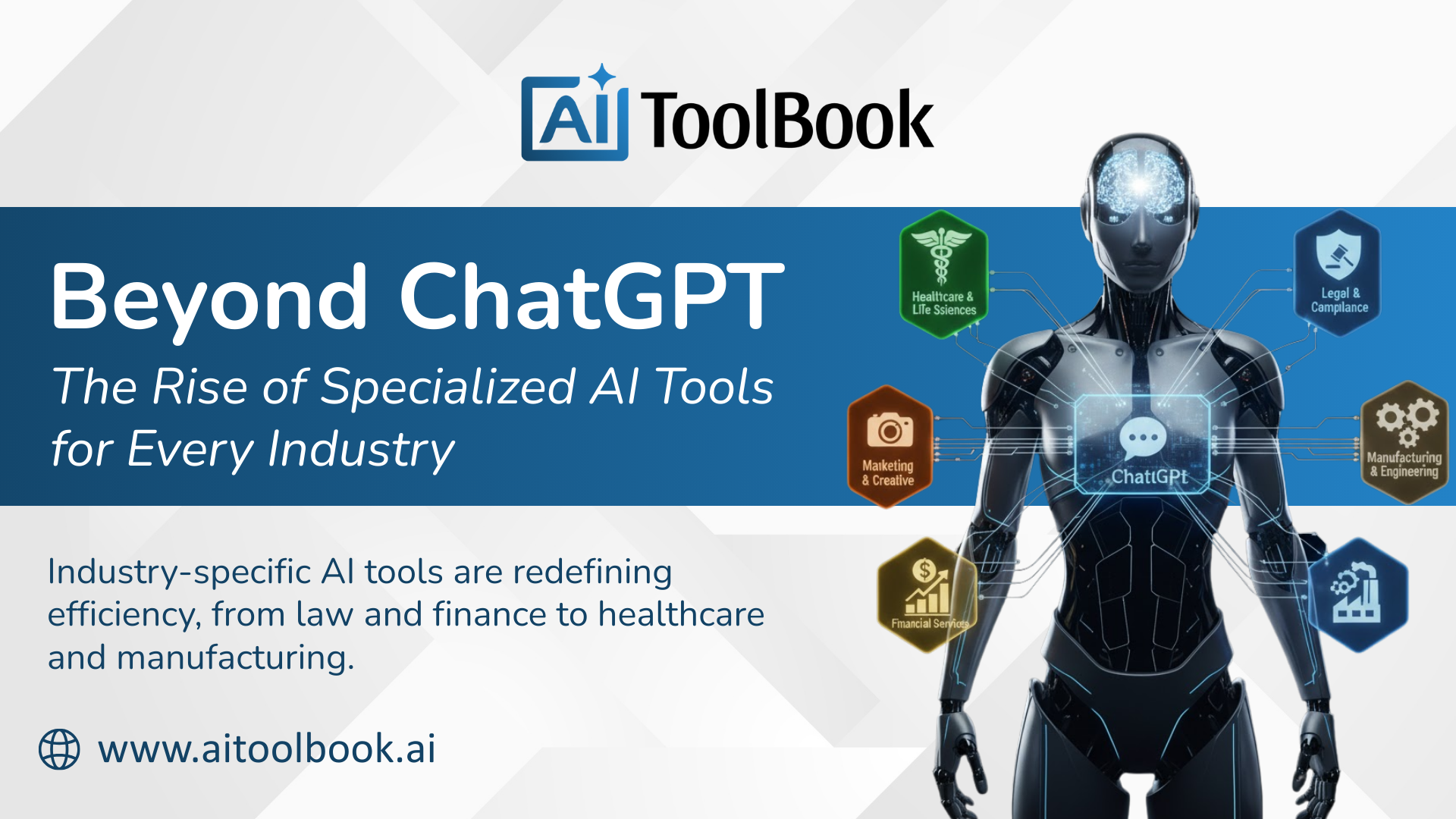
But here's what we've learned in the months since: while ChatGPT opened the door, it was just the beginning. The real AI revolution isn't happening in one general-purpose tool—it's unfolding across thousands of specialized applications designed to solve specific problems in specific industries.
The Specialization Movement Think about it this way: you wouldn't use a Swiss Army knife to perform surgery, even though it technically has a blade. The same principle applies to AI tools. While ChatGPT excels at general conversation and broad writing tasks, specialized AI tools are emerging that outperform it dramatically in their specific domains.
Take legal research, for example. Tools like Harvey AI and LexisNexis+ are built specifically for attorneys, trained on legal documents and case law. They understand legal terminology, precedent structures, and regulatory frameworks in ways that general AI simply cannot match. A personal injury lawyer using these tools can find relevant case precedents in minutes rather than hours.
The pattern repeats across industries. In healthcare, tools like Aidoc specialize in medical imaging analysis. In finance, platforms like DataSnipper focus on audit documentation. For creative professionals, tools like Midjourney revolutionized image generation while RunwayML transformed video editing workflows.
Industry-Specific Solutions Taking Center Stage Healthcare & Life Sciences The healthcare sector has embraced AI tools that go far beyond basic chatbots. Diagnostic imaging tools can spot early-stage cancers that human radiologists might miss. Drug discovery platforms are accelerating the development of new treatments by years. Electronic health record systems now integrate AI assistants that help doctors identify potential drug interactions and treatment protocols.
Legal & Compliance Law firms are discovering that AI tools built for legal work vastly outperform general AI. Contract analysis tools can review hundreds of pages of legal documents in minutes, flagging potential issues and suggesting revisions. Compliance monitoring systems help businesses stay ahead of changing regulations across multiple jurisdictions.
Marketing & Creative Industries Beyond simple content generation, specialized marketing AI tools are transforming how brands connect with customers. Social media management platforms use AI to optimize posting schedules and engagement strategies. Video editing tools now offer AI-powered color correction, automatic subtitle generation, and even AI-generated B-roll footage.
Manufacturing & Engineering Smart factories are deploying AI tools for predictive maintenance, quality control, and supply chain optimization. These aren't general-purpose AI applications—they're specialized systems trained on manufacturing data, understanding machine patterns, production schedules, and maintenance requirements.
Financial Services The finance industry has moved beyond simple chatbots to sophisticated AI systems for fraud detection, algorithmic trading, risk assessment, and regulatory compliance. These tools process millions of transactions in real-time, identifying patterns that would be impossible for human analysts to spot.
The Power of Purpose-Built AI What makes these specialized tools so effective? Several key factors:
Domain Expertise : Specialized AI tools are trained on industry-specific data, making them incredibly knowledgeable about sector-specific challenges, terminology, and best practices.
Workflow Integration : Unlike general AI tools that require you to adapt your workflow, specialized tools are built to fit seamlessly into existing industry processes and software ecosystems.
Regulatory Compliance : Many industries have strict compliance requirements. Specialized tools are designed with these regulations in mind, ensuring that AI-generated outputs meet industry standards and legal requirements.
Performance Optimization : When an AI tool is built for a specific task, it can be optimized for speed, accuracy, and reliability in that particular use case.
Navigating the Specialized AI Landscape With thousands of AI tools now available, the biggest challenge isn't finding AI solutions—it's finding the right ones for your specific needs. This is where the importance of curation becomes clear.
The explosion of specialized AI tools has created a new problem: discovery. How do you find the best AI tool for legal document review? Which customer service AI platform works best for e-commerce businesses? What about AI tools specifically designed for small manufacturing companies?
This is exactly why platforms like AI ToolBook have become essential resources for professionals across industries. Rather than spending hours researching and testing different AI tools, professionals can access curated directories that categorize tools by industry, use case, and functionality.
AI ToolBook serves as a comprehensive guide through this specialized landscape, helping businesses discover tools they might never have found otherwise. The platform's detailed categorization system makes it easy to find AI solutions tailored to specific industries and use cases, complete with user reviews and detailed feature comparisons.
The Future Is Specialized As we move further into 2025, the trend toward specialization will only accelerate. We're already seeing the emergence of AI tools designed for incredibly specific niches—from AI assistants for veterinary clinics to specialized tools for managing renewable energy projects.
This specialization trend benefits everyone. Businesses get more effective tools that solve their specific problems. AI developers can focus on creating best-in-class solutions rather than trying to be everything to everyone. And users get AI experiences that feel tailor-made for their workflows.
The companies that will thrive in this new AI landscape are those that move beyond the general-purpose AI tools and embrace specialized solutions designed for their specific needs. But success requires making informed choices about which tools to adopt—and that's where expert curation and guidance become invaluable.
Making the Right Choice The shift from general AI to specialized tools represents a maturation of the artificial intelligence industry. Just as software evolved from general-purpose applications to specialized industry solutions, AI is following the same path.
For business leaders, the message is clear: while ChatGPT might have introduced you to AI, the tools that will truly transform your business are the specialized solutions designed specifically for your industry and use cases.
The question isn't whether you should be using AI—it's whether you're using the right AI tools for your specific needs. With platforms like AI ToolBook making it easier to discover and evaluate specialized AI solutions, there's never been a better time to move beyond general AI and embrace the specialized tools that can truly transform how you work.
The AI revolution is just getting started, and the most exciting developments are happening in the specialized tools designed to solve real-world problems in specific industries. The future belongs to those who choose their AI tools as carefully as they choose any other critical business technology—with a focus on specific needs, proven results, and long-term value.
Ready to discover the specialized AI tools that could transform your industry? Visit AI ToolBook to explore curated AI solutions tailored to your specific business needs.
Contribute to ATB
We welcome contributions from anyone passionate about AI. Write a blog or article, and we'll publish it on our website and social channels — reaching thousands of readers. Every post is published with your name as the author, giving you visibility and credibility in the AI community.
Stay Ahead of AI
Don't miss the latest tools, reviews, and insights that are shaping the future of work and creativity. ATB Weekly brings you one curated email every week — no fluff, just practical AI knowledge. Subscribe today and join thousands of readers who are already using AI ToolBook to discover smarter tools, save time, and stay one step ahead.
*By subscribing, you agree to receive emails from AI ToolBook. You can unsubscribe anytime.